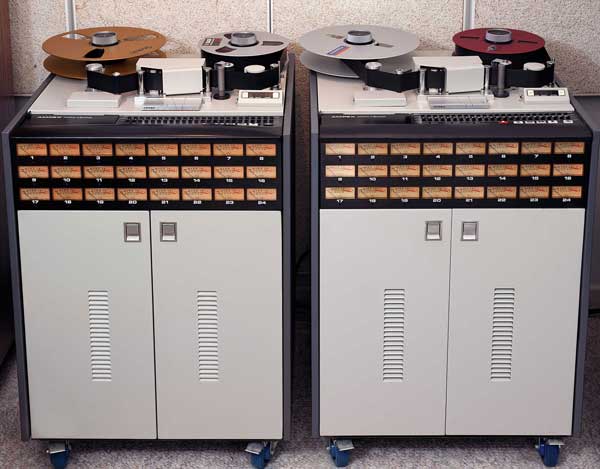
We rely on a fleet of fully restored and extensively modified Ampex MM1200 machines to handle 2″, 1″, and various other multitrack configurations:
Why the Ampex MM1200?
Thanks to countless hours of research and prototyping, our MM1200 modifications yield detail and clarity well beyond the stock performance, providing pristine playback of your valuable reels.
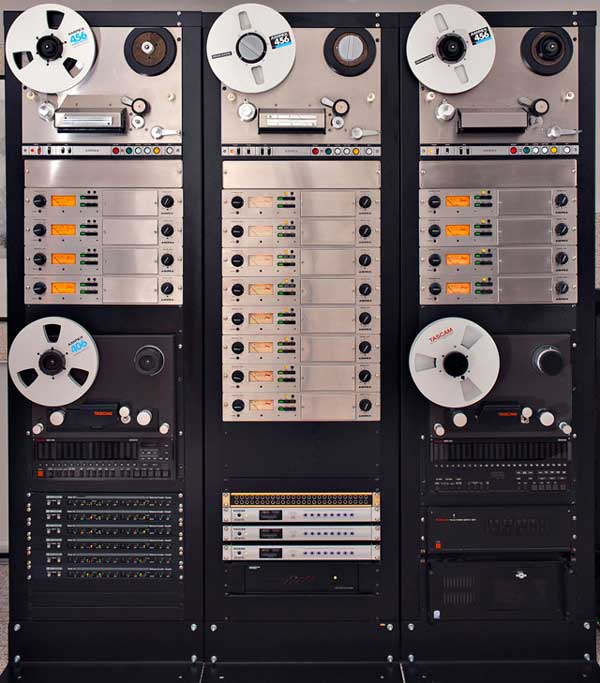
Our Ampex 440C machines are fully rebuilt with:
This setup accommodates:
They also serve as an ideal platform for prototyping advanced tape path modifications, ensuring phenomenal accuracy and “pleasantly transparent” sound.
For semi-pro or project studio formats, we maintain Tascam MSR-16 (½″ 16-track) and MSR-24 (1″ 24-track) machines. We combine them with professional-grade Dolby 422 and dbx noise reduction racks to achieve fidelity beyond the stock consumer circuits, unlocking fuller bass and more open highs in older recordings.
Ampex ATR-104
Half-inch 2, 3, and 4-track tapes and quarter-inch 2-track tapes can be transferred on this Ampex ATR-104 lovingly maintained to our uncompromising standards.
Studer A-80 JKC
Never heard of this model? That’s right!
We have completely redesigned the entire playback system in this machine. A Flux Magnetics playback head was custom built by Greg Orton and mated with totally redesigned playback electronics by our own John Chester. The sonic purity of this machine is absolutely stunning and, for transparency, outperforms anything we’ve ever heard or tested.
Especially delicate 1/4″ 2-track tapes are best played on this fully restored Studer A80 RC.
Tapes recorded and stored on European AEG / DIN hubs can be played as-is or moved to standard NAB reels for transfer on any of the A2DX 1/4″ mastering machines.
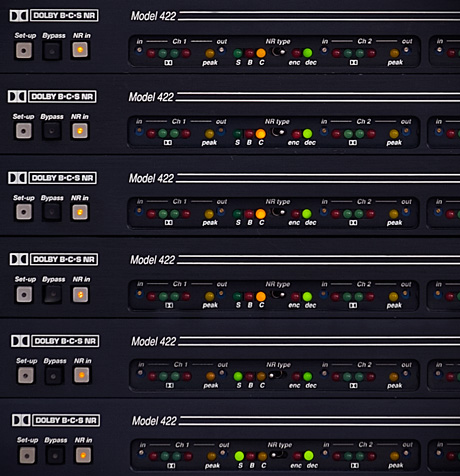
If your 1/4″ 8-track, 1/2″ 16-track or 1″ 24-track tapes were recorded on Fostex or Tascam machines, we have important information for you. The bad news is, all of the Fostex G-Series machines are currently disintegrating due to defective early surface mount technology used to manufacture them. And, Fostex and Tascam machines that utilized Dolby C or S noise reduction are also failing due to permanent degradation of the consumer-grade Dolby NR chip sets used in their manufacture. The good news is that we have the ultimate solution.
Determined that no client’s tapes should be orphaned, we tracked down and installed 24 tracks of professional Dolby 422 B-C-S decoders. We can now bypass the failing noise reduction circuits built into the machines and use these decoders instead.
This cloud has a silver lining. By installing these Dolby 422s, we solved a lot more than the problem with failing noise reduction circuits in the machines. We can now make transfers remarkably better than any that could ever have been made on stock Tascam and Fostex machines. First, Dolby 422 decoders deliver stronger, fuller bass and quicker, more open midrange and highs than the stock machine’s consumer chip sets ever did. And, second, their ready adjustability allows us to tune them individually to your tapes for tighter, cleaner, more open sound.
This is not just a subtle tweak. It’s a significant upgrade. If your 1/4″ 8-track, 1/2″ 16-track or 1″ 24-track recordings were made using Dolby noise reduction, you’ll hear the music on them like never before.
Fortunately, machines using dbx noise reduction are holding up much better. But we still bypass the consumer grade decoders built into them and take advantage of our professional dbx rack for the sonic upgrade it provides.
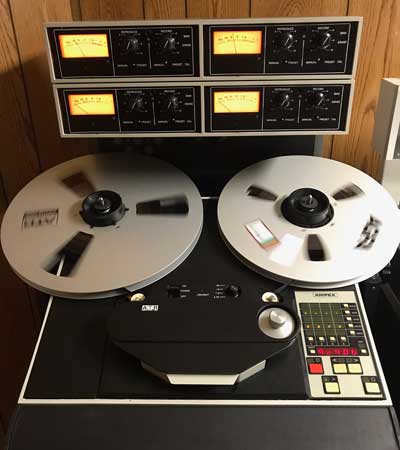
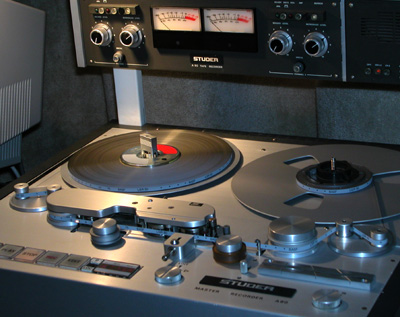
Half-inch 2, 3, and 4-track tapes and quarter-inch 2-track tapes can be transferred on this Ampex ATR-100 fully rebuilt from the ground up to our uncompromising standards. Especially delicate 1/4″ 2-track tapes are best played on this fully restored Studer A80 RC.
Additionally, we have completely redesigned the entire playback system in this machine. A Flux Magnetics playback head was custom built by Greg Orton and mated with totally redesigned playback electronics by our own John Chester. The sonic purity of this machine is absolutely stunning and, for transparency, outperforms anything we’ve ever heard or tested.
Tapes recorded and stored on European AEG / DIN hubs can be played as-is or moved to standard NAB reels for transfer on any of the A2DX 1/4″ mastering machines.

Noise Reduction
Sonicraft A2DX maintains the full range of professional noise reduction systems including 24-track racks of Dolby A, Dolby SR, Telcom C4, and dbx Type I.
Sorting through the many configurations of professional noise reduction systems was an enormous job. We needed to be sure that the latest versions of each were indeed the best and would be fully backwards-compatible with tapes made on earlier systems. We purchased, rented and evaluated practically every style of Dolby and dbx noise reduction system. In fact, for dbx Type I decoding, we purchased and evaluated a total of six different dbx multitrack noise reduction systems before we made our final decision.
Both the Dolby A system and the Dolby SR system are Dolby’s latest design and are housed in XP racks. The dbx Type I (professional) system utilizes 911 modules in 900A frames.
Also installed are 24 tracks of Dolby S and 16 tracks of Dolby B & C in the form of six Dolby 422 professional systems. Each of these represents the latest and best of its kind, all meticulously maintained and calibrated.
The ADC Converters
Sonicraft A2DX analog-to-digital converters are current Mytek 8X192 units capable of up to 192kHz / 24-bit sampling. We chose the Mytek Brooklyn ADC for our stereo workstation because it delivered the same attention to detail as the 8x192s with the added boost of up to 384 kHz sampling, which comes in handy not only for exceptional transfers but also as an evaluative tool for understanding the entirety of the infrasonic and ultrasonic signals recorded to your tapes.
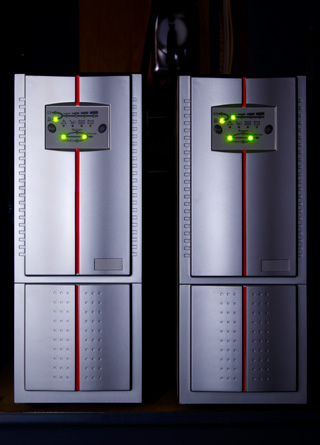
During fast-forward or rewind, it’s not uncommon for tape to reach speeds in excess of 20mph. So, what happens to your tape if the power fails while the machine operator is rewinding it? Here at Sonicraft, the answer is “absolutely nothing”. That’s because at all times, Sonicraft A2DX lab runsentirely on battery power.
Nothing is running off of public utility power — not even the digital audio workstations. Instead, the public utility power is used to charge batteries. This battery power is fed to a pair of very high grade of inverters which together produce 5000 watts of exactly 120 volt pure 60 Hz sine wave power — enough to power the entire lab with complete ease.
5000 watts of 100% stable battery power means bulletproof power reliability, rock-solid tape transport behavior, and super-clean ultra-regulated power to the analog circuits of tape machines and noise reduction systems, A2D converters, digital audio workstations and anything else your transfers come into contact with. It’s every sound purist’s dream come true.
As for audio wiring in the Sonicraft A2DX transfer lab, all of it is done in short discrete runs of the very highest quality and heaviest gauge Mogami or Canare cable. All patch bays and patch cords are quarter-inch military grade products and all connections are meticulously hand-soldered. And we have implemented sophisticated technology that isolates the analog equipment from the power fed to the computers.
